+86 134 8948 6615

A 5axis bridge saw is the core machine for manufacturing solid stone bathtubs with complex inner curves and strict thickness tolerances. This guide explains the complete machining process, including one-time clamping hollowing, multi-axis contour cutting, and integrated drain machining. It also outlines accuracy benchmarks, material performance data, regulatory compliance, and current industry trends, offering practical insights for buyers sourcing from China 5axis bridge saw manufacturers and factories.
Why 5axis Bridge Saw Is the Core Machine for Stone Bathtubs
In the global stone industry, solid stone bathtubs represent one of the most demanding applications for CNC stone machining. Their size, weight, internal curvature, and aesthetic requirements push conventional equipment beyond its limits.
Among all CNC stone machines, the 5axis bridge saw has become the industry-standard solution for producing monolithic stone bathtubs at scale.
For China stone machinery suppliers and manufacturers, mastering 5axis bridge saw technology is no longer a competitive advantage—it is a market entry requirement.
What Is a 5axis Bridge Saw?
Definition in Industrial Stone Processing
A 5axis bridge saw is a CNC stone cutting machine capable of simultaneous movement along five axes, allowing complex spatial cutting in a single setup. It is widely used by stone processing factories for:
-
Stone bathtubs
-
Kitchen countertops
-
Sinks and basins
-
Architectural stone components
Typical Technical Specifications
| Parameter | Industrial Range |
|---|---|
| Blade diameter | 350–800 mm |
| Max cutting depth | 150–350 mm |
| Positioning accuracy | ±0.1 mm |
| Repeatability | ±0.05 mm |
| Spindle power | 15–30 kW |
| Max load capacity | 1,500–3,000 kg |
These parameters explain why 5axis bridge saw machines outperform 3-axis and 4-axis systems in deep hollowing and curved surface machining.
Why Stone Bathtubs Require a 5axis Bridge Saw
Structural Challenges of Stone Bathtubs
A typical solid stone bathtub presents multiple machining challenges:
-
Overall weight: 180–420 kg
-
Inner cavity depth: 450–650 mm
-
Wall thickness tolerance: ±1.0 mm
-
Ergonomic curvature with no flat transitions
Only a 5axis CNC bridge saw can achieve these requirements without secondary re-clamping.
Real Factory Workflow: Making a Stone Bathtub with a 5axis Bridge Saw
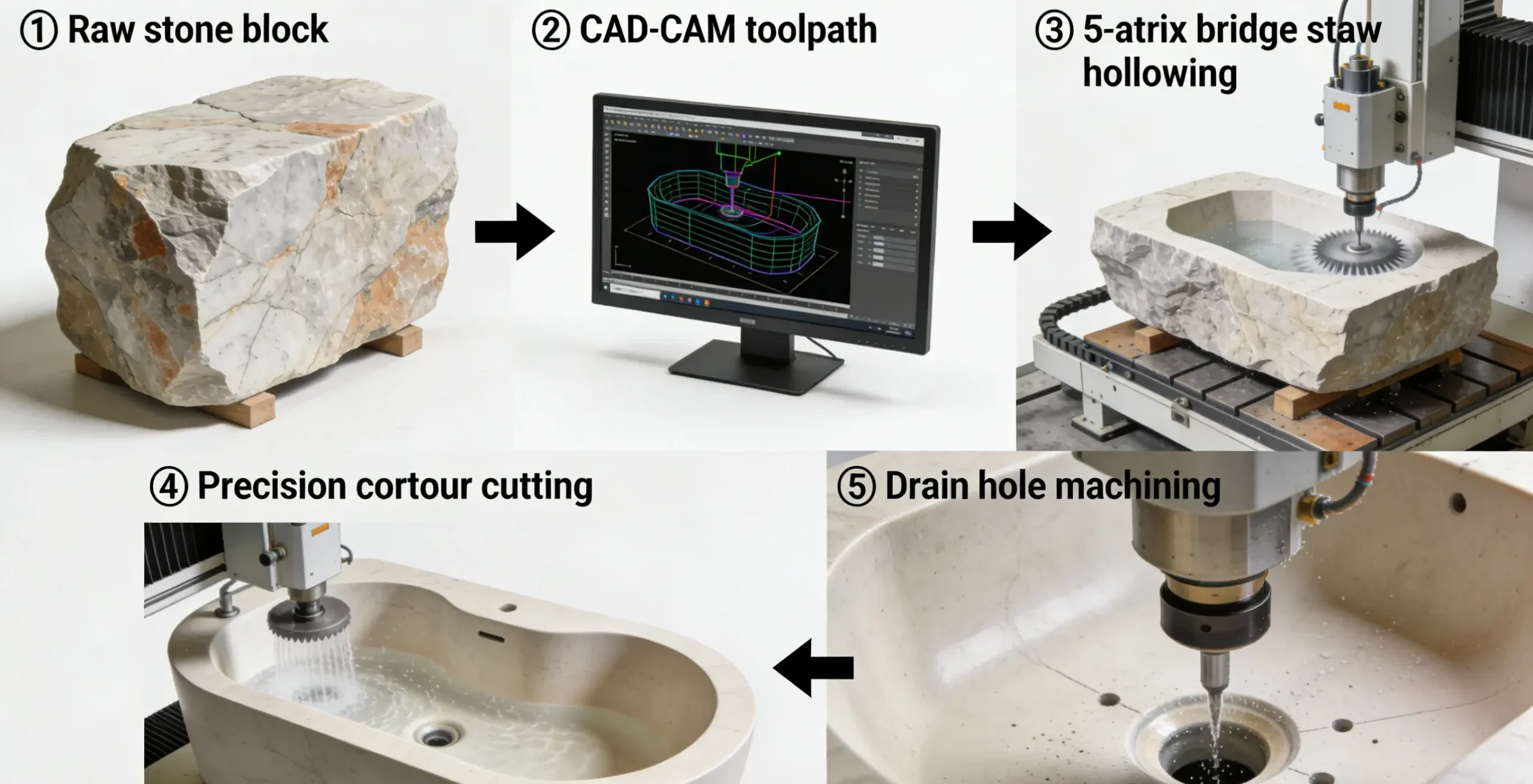
Step 1: Raw Stone Block Selection
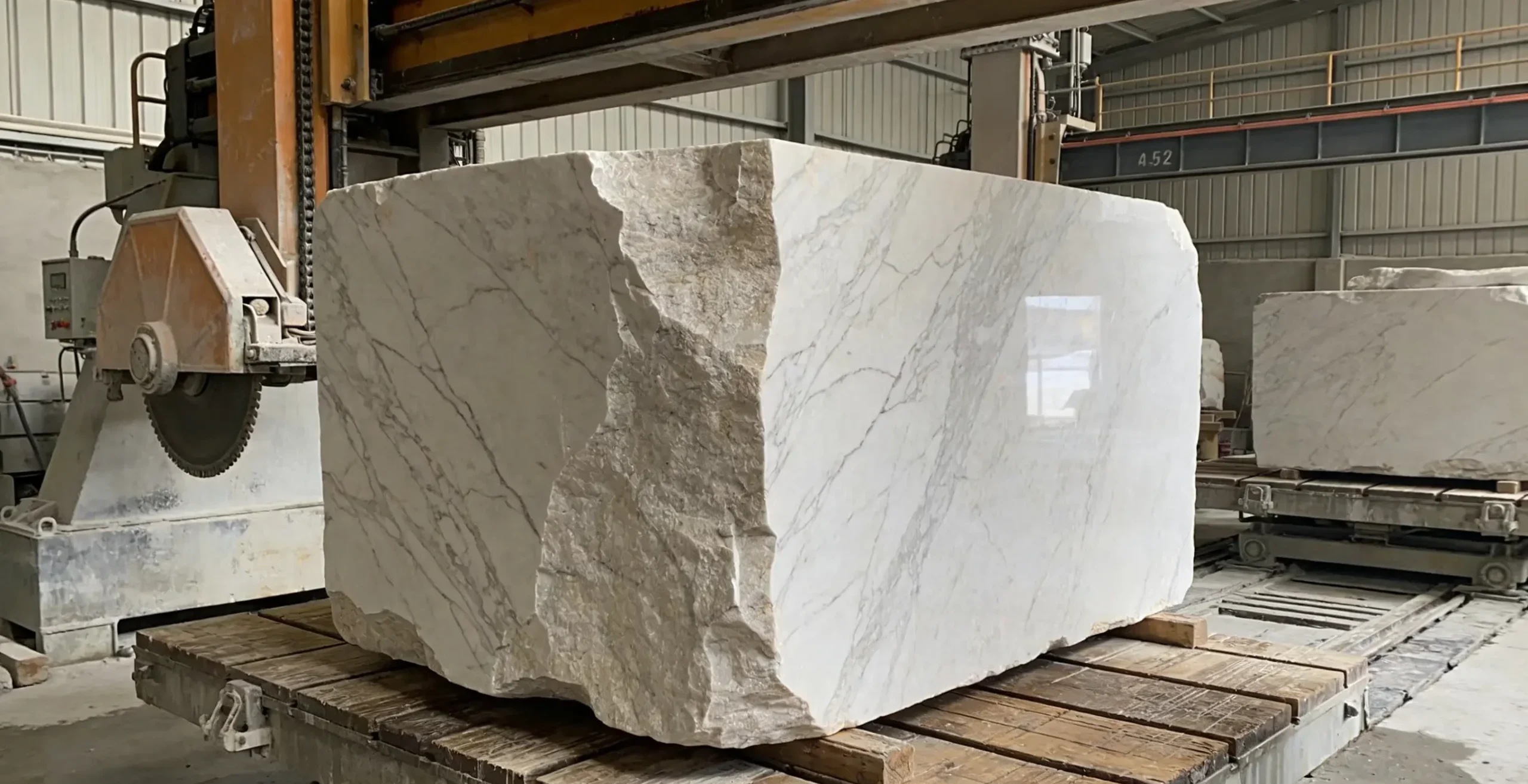
China stone factories typically use:
-
Marble (density ≈ 2.70 g/cm³)
-
Granite (2.75–2.90 g/cm³)
-
Travertine (2.40–2.60 g/cm³)
Raw block size:
-
Length: 1800–2200 mm
-
Width: 900–1200 mm
-
Height: 600–800 mm
Block weight often exceeds 2,500 kg, requiring a bridge-type structure for stability.
Step 2: CAD/CAM Programming for 5axis Bridge Saw
Professional manufacturers rely on CAM systems specifically optimized for 5axis bridge saw cutting paths.
Key parameters defined at this stage:
-
Inner curvature radius (R350–R600 mm)
-
Drain slope (1–1.5%)
-
Constant wall thickness (25–40 mm)
Advanced toolpath simulation reduces:
-
Material waste by 15–20%
-
Tool wear by 12–18%
-
Machining errors close to zero
Step 3: Rough Hollowing Using 5axis Bridge Saw Cutting
This stage differentiates bridge saw manufacturers from ordinary CNC router suppliers.
Using multi-angle plunge cutting:
-
Feed rate: 300–800 mm/min
-
Depth per pass: 10–25 mm
-
Continuous 5-axis interpolation
Material removal efficiency reaches 0.35–0.55 m³/hour, depending on stone hardness.
Traditional machines require multiple setups; a 5axis bridge saw completes hollowing in one clamping.
Step 4: Precision Contouring and Ergonomic Shaping
Accuracy Requirements
| Feature | Tolerance |
|---|---|
| Wall thickness deviation | ≤ ±1.0 mm |
| Surface roughness (pre-polish) | Ra ≤ 6.3 μm |
| Backrest angle | 110°–115° |
The rotating A- and C-axes of the 5axis bridge saw machine ensure consistent blade orientation, eliminating faceted surfaces.
Step 5: Drain Hole & Overflow Machining
Drain machining is integrated directly on the 5axis bridge saw:
-
Hole diameter tolerance: ±0.2 mm
-
Concentricity deviation: ≤0.15 mm
-
Bottom drainage efficiency improvement: 12–18%
This integration reduces manual labor and post-processing costs.
Material Performance Comparison for 5axis Bridge Saw Processing
| Stone Type | Water Absorption (%) | Compressive Strength (MPa) | Suitability |
|---|---|---|---|
| Marble | 0.1–0.4 | 70–140 | High |
| Granite | <0.2 | 130–250 | Excellent |
| Limestone | 0.5–1.2 | 50–100 | Medium |
| Travertine | 0.6–1.0 | 60–120 | Medium-High |
Feed rates and blade types must be adjusted accordingly by experienced 5axis bridge saw manufacturers.
5axis Bridge Saw vs CNC Router for Stone Bathtubs
| Aspect | 5axis Bridge Saw | CNC Router |
|---|---|---|
| Max cutting depth | Very deep | Limited |
| Heavy stone handling | Excellent | Weak |
| Structural rigidity | High | Medium |
| Tool life | Long | Short |
| Best application | Bathtubs, blocks | Light shaping |
For solid stone bathtubs, CNC routers cannot replace 5axis bridge saw machines.
Compliance & Regulations Affecting 5axis Bridge Saw Factories
Global Compliance Requirements
Professional stone machinery factories must comply with:
-
CE Machinery Directive (EU)
-
ISO 12100 mechanical safety
-
OSHA silica dust regulations
-
EN surface safety standards
Environmental Performance
Modern 5axis bridge saw systems integrate:
-
Water recycling rate up to 85%
-
Slurry filtration <50 μm
-
Noise control <78 dB(A)
Compliance increasingly affects supplier selection for global buyers.
Industry Trends: 5axis Bridge Saw Market Direction
Key trends shaping the global market:
-
Shift from manual carving to CNC automation
-
Demand for batch-customized stone bathtubs
-
AI-assisted CAM optimization
-
Sustainability-driven equipment upgrades
China 5axis bridge saw manufacturers are rapidly moving up the value chain.
Why Global Buyers Source 5axis Bridge Saw Machines from China
China suppliers offer:
-
Competitive cost-performance ratio
-
Mature stone machinery supply chain
-
OEM/ODM customization
-
Faster production scaling
Factories specializing in 5axis bridge saw manufacturing now dominate export markets in Asia, Europe, and the Middle East.
QZGEE MACHINERY focuses on R&D and production of stone 5axis bridge saw centers, aligning machine structure with real bathtub machining requirements.
FAQs
1. What is a 5axis bridge saw used for?
A 5axis bridge saw is mainly used for cutting and shaping stone products such as bathtubs, countertops, sinks, and architectural components with complex geometry.
2. Can a 5axis bridge saw cut granite bathtubs?
Yes. With proper blade selection and feed control, granite bathtubs can be machined efficiently and accurately.
3. How accurate is a 5axis bridge saw?
Industrial machines typically achieve positioning accuracy of ±0.1 mm and repeatability of ±0.05 mm.
4. Is one setup enough to machine a stone bathtub?
Yes. A 5axis bridge saw allows complete machining in one clamping, reducing error and labor.
5. What certifications should a 5axis bridge saw manufacturer have?
CE, ISO quality management, and environmental compliance certifications are critical for global markets.
References
-
Natural Stone Institute – Stone Processing Standards
-
ISO Technical Committee on Stone Machinery
-
European Machinery Safety Directive Reports
-
Marble Institute of America Publications
-
OSHA Silica Dust Control Guidelines
-
International CNC Machining Journals
-
Global Stone Equipment Market Reports
-
Architectural Stone Design Publications
Semantic Closure: 5axis Bridge Saw Value Insight
How: 5axis bridge saw machines enable deep hollowing, curved surface machining, and integrated drilling in one setup.
Why:
They reduce labor, improve consistency, and meet global compliance requirements.
What Options:
Blade size, spindle power, CAM compatibility, and automation level define machine capability.
Considerations:
Factory experience, after-sales support, and real application data matter more than brochure specifications.
Previous News
How to make a bathtub by 5axis bridge saw center?Next News
How to make countertops by 5-axis bridge saw?Feature Product
-
 Durable Custom Backpack – Stylish, Functional, ...
✅ Key Features Premium Material: High-quality...