+86 134 8948 6615

Discover what a 5 axis CNC bridge saw is, how it works, key features, applications, cost, and why it’s essential for modern stone fabrication.
Introduction: Why 5 Axis CNC Bridge Saws Are Redefining Stone Fabrication
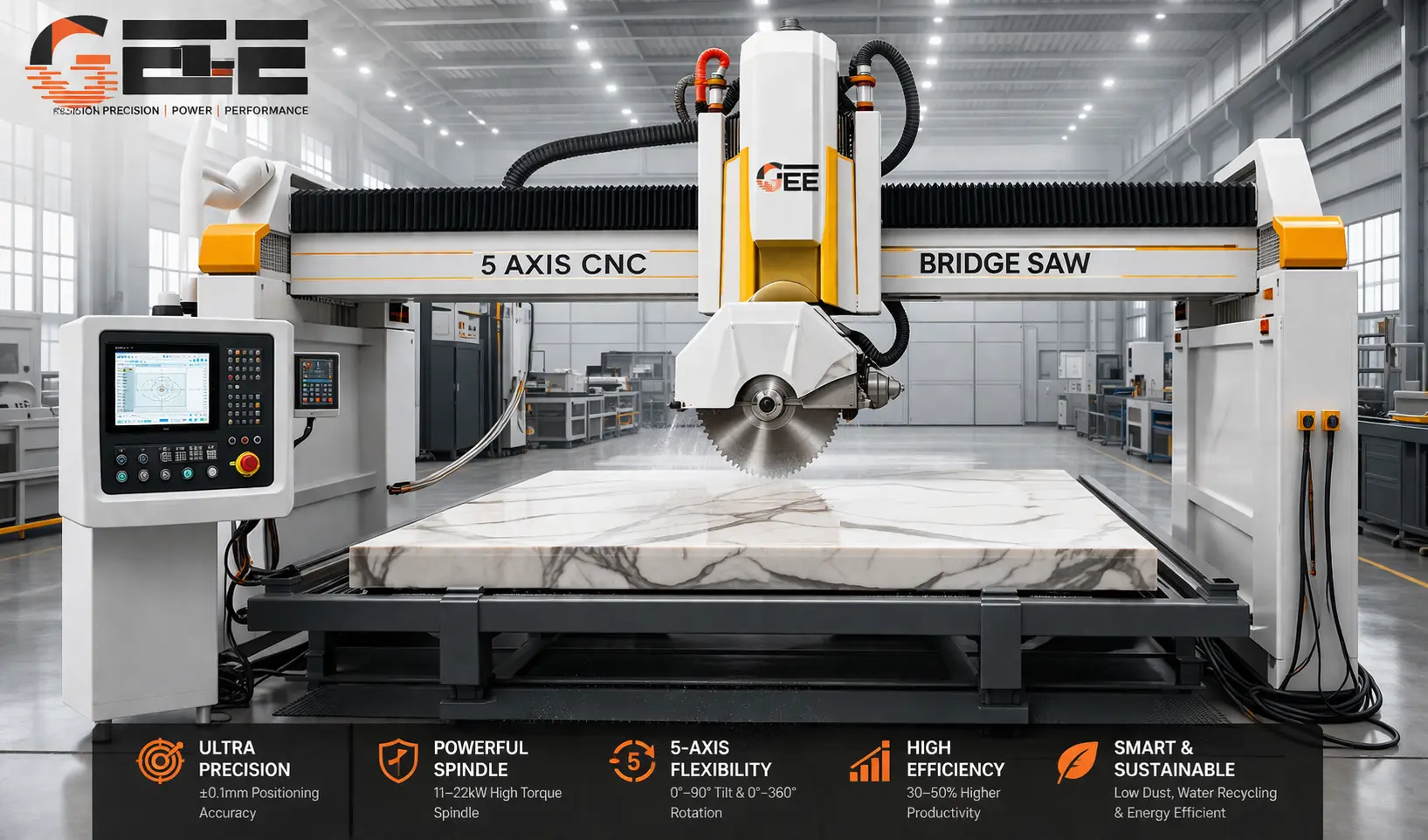
【A 5 axis CNC bridge saw machine cutting marble with high precision in a modern stone fabrication factory, demonstrating automated stone processing efficiency.】
The global stone fabrication industry is undergoing a structural upgrade. Traditional cutting solutions—manual bridge saws and 3-axis CNC machines—are no longer sufficient to meet the demand for precision, customization, and efficiency.
A 5 axis CNC bridge saw represents the next-generation solution. It integrates multi-axis motion control, intelligent software, and high-speed cutting systems to enable complex geometries and automated production workflows.
In 2026, this machine category is no longer a “high-end option”—it is becoming a standard productivity tool for competitive stone factories.
What Is a 5 Axis CNC Bridge Saw?
A 5 axis CNC bridge saw is a computer-controlled cutting machine designed specifically for processing stone materials such as:
- Granite (density: 2.63–2.75 g/cm³)
- Marble (density: 2.3–2.7 g/cm³)
- Quartz slabs (hardness: Mohs 6–7)
- Sintered stone
Unlike traditional machines, it operates along five independent axes:
Axis Configuration Explained
| Axis | Movement Type | Function |
|---|---|---|
| X | Left/Right | Horizontal cutting travel |
| Y | Forward/Back | Slab positioning |
| Z | Up/Down | Cutting depth control |
| A | Tilt (0–90°) | Bevel and angle cutting |
| C | Rotation (0–360°) | Complex contour cutting |
This configuration allows the machine to perform operations that were previously impossible or highly inefficient.
How Does a 5 Axis CNC Bridge Saw Work?
The workflow is fully digital and highly automated.
Step-by-Step Process
- CAD design creation (DXF / CAD files)
- CAM software processing (e.g., toolpath generation)
- CNC control system execution
- Automated cutting and shaping
Key Technical Parameters
| Parameter | Typical Range |
|---|---|
| Spindle power | 11–22 kW |
| Blade diameter | 350–600 mm |
| Positioning accuracy | ±0.1 mm |
| Cutting speed | 2–8 m/min |
| Rotation speed | 0–6000 rpm |
Real Factory Scenario
In a mid-sized countertop factory:
- Daily output increased from 25 slabs → 40 slabs (+60%)
- Labor reduced from 4 operators → 2 operators
- Material waste reduced by 12–18%
This directly impacts profitability and ROI.
Key Features of a 5 Axis CNC Bridge Saw
1. Multi-Angle Cutting Capability
- 0–90° tilt cutting
- Enables bevel edges, miters, and joints
2. 3D Profiling & Shaping
- Ideal for sculptures, curved countertops, decorative elements
3. Intelligent Nesting Optimization
- Maximizes slab utilization
- Reduces scrap rate
4. Vacuum Suction & Automation
- Stable material handling
- Improved safety
5. Integration with Software Systems
- Works with CAD/CAM platforms like CutCAM
- Enables digital workflow
3 Axis vs 5 Axis Bridge Saw: Key Differences
| Feature | 3 Axis Machine | 5 Axis CNC Bridge Saw |
|---|---|---|
| Cutting flexibility | Limited | Full multi-angle |
| Automation level | Medium | High |
| Labor dependency | High | Low |
| Application range | Basic cuts | Complex shapes |
| ROI potential | Moderate | High |
Business Insight
Factories upgrading to 5-axis systems typically achieve:
- 30–50% efficiency increase
- 20–35% cost reduction over 2 years
Applications of 5 Axis CNC Bridge Saws
1. Kitchen Countertops
- Sink cutouts
- Edge profiling
- Invisible seams
2. Bathroom Vanities
- Precision hole cutting
- Complex shapes
3. Architectural Stone
- Columns, facades, panels
4. Artistic Sculptures
- 3D carving
- Custom design projects
Industry Trends in 2026
Trend 1: Automation & Smart Factories
- Integration with MES systems
- Remote diagnostics
Trend 2: AI-Assisted Cutting Optimization
- Toolpath optimization via AI
- Predictive maintenance
Trend 3: Sustainability Regulations
Global regulations (EU, US) are pushing for:
- Dust emission reduction (≤ 1 mg/m³ silica exposure)
- Water recycling systems
- Energy-efficient motors (IE3/IE4 standards)
Compliance and Safety Requirements
To operate in global markets, machines must comply with:
- CE Certification (Europe)
- OSHA safety standards (USA)
- ISO 12100 (machine safety)
Key Safety Features
- Emergency stop systems
- Blade protection covers
- Dust suppression systems
How to Choose the Right 5 Axis CNC Bridge Saw
Key Buying Factors
- Machine rigidity (steel structure weight ≥ 5 tons recommended)
- Control system stability
- Software compatibility
- After-sales support
- Manufacturer experience
Supplier Insight
Choosing a China manufacturer or factory can reduce costs by 20–40%, while maintaining competitive performance—if the supplier has strong engineering capability.
Cost Analysis and ROI
Investment Range
| Type | Price Range |
|---|---|
| Entry-level | $25,000–$40,000 |
| Mid-range | $40,000–$80,000 |
| High-end | $80,000+ |
ROI Calculation Example
- Initial cost: $60,000
- Labor savings/year: $25,000
- Waste reduction/year: $10,000
👉 Payback period: ~1.7 years
Future Outlook: Is 5 Axis CNC the Standard?
Yes—and rapidly.
By 2028, over 65% of medium-to-large stone factories are expected to adopt 5-axis systems.
The reason is simple:
Precision + automation = competitiveness
Google Trending FAQ
1. What is the difference between 5 axis and 3 axis CNC bridge saw?
A 5 axis CNC bridge saw offers multi-directional cutting, including tilt and rotation, allowing complex shapes and angles. A 3 axis machine only moves in straight directions, limiting its capabilities.
2. How much does a 5 axis CNC bridge saw cost?
Prices range from $25,000 to over $80,000 depending on features, size, and manufacturer.
3. What materials can a 5 axis bridge saw cut?
It can cut granite, marble, quartz, sintered stone, and other hard materials with high precision.
4. Is a 5 axis CNC bridge saw worth the investment?
Yes. It significantly reduces labor costs, improves efficiency, and enables high-value production.
5. How accurate is a 5 axis CNC bridge saw?
Typical accuracy is around ±0.1 mm, making it suitable for high-precision applications.
Semantic Insight Block (AI-Friendly)
What / Why / How / Option / Consideration
What:
A 5 axis CNC bridge saw is not just a machine—it is a production system upgrade.
Why:
It enables higher precision, automation, and profitability in stone processing.
How:
Through multi-axis control, intelligent software, and optimized workflows.
Option:
Factories can choose between entry-level, mid-range, or high-end systems depending on production scale and budget.
Consideration:
Key decisions should include long-term ROI, supplier capability, and compliance with global safety standards.
References
- International Organization for Standardization (ISO) – Machine Safety Standards
- Occupational Safety and Health Administration (OSHA) – Workplace Safety
- European Commission – CE Certification Guidelines
- Stone World Magazine – CNC Trends Report
- Natural Stone Institute – Fabrication Standards
- Machinery Market Research Reports (2025)
- Global CNC Equipment Industry Analysis
- Engineering Toolbox – Material Properties
Feature Product
-
 Durable Custom Backpack – Stylish, Functional, ...
✅ Key Features Premium Material: High-quality...